
One Framework, Multiple Offers
How to Turn Your Expertise Into a Progression of Related Offers
If you're an experienced professional building an online business, at some point you're going to ask: What should I offer?
Should you create a book? A workshop? An online course? Group coaching? Consulting? A membership?
Those are all legitimate possibilities. But there's a problem with starting there.
They're all delivery formats. They describe how you might deliver your expertise, but they don't answer the more important question: What transformation will you help your client achieve?
Start With the Transformation
Your Signature Transformation Framework describes how you help a client move from where they are now to where they aspire to be.
That transformation might involve three steps, five steps, eight steps, or something entirely different. What's important is that you've structured your expertise into a process that produces a meaningful result.
Within that larger transformation are usually several smaller transformations. I call these framework splinters. And those splinters give you the raw material for creating offers.
The basic formula is:
Framework Splinter + Delivery Format = Offer
For example, you might take the first part of your framework and deliver it through a live workshop. Another portion might become a group coaching program. A more advanced portion could become a mastermind. And you might offer your entire framework through private coaching or consulting.
You're not inventing a collection of unrelated products. You're creating different ways for clients to experience and benefit from the same underlying expertise.
Create a Progression of Related Offers
Once you begin thinking this way, you can create offers that correspond to different stages of your customer journey.
At the beginning of the relationship, someone may not be ready to make a significant investment with you. They may start with a free resource such as a guide, webinar, video training, mini-course, newsletter, podcast, or community.
From there, you can provide opportunities to take the relationship further.
An entry offer, perhaps a book, workshop, or introductory course, gives someone a relatively low-risk opportunity to experience your expertise.
A core offer can provide a more substantial transformation through a multi-week course, group coaching program, live training experience, community, or professional service.
And a premium offer might provide deeper access to you through private coaching, consulting, professional services, or a longer-term mastermind.
As clients progress from free through entry, core, and premium offers, both their commitment and the value you provide can increase.
Match Your Pricing to the Value
This leads naturally to pricing. Price shouldn't simply be determined by whether something is called a course, workshop, or coaching program. Think instead about the value of the result you're helping the client achieve.
A useful way of thinking about perceived value is an equation developed by Alex Hormozi:
Value = (Result × Likelihood of Success) ÷ (Time × Effort)
The more valuable the result and the greater the client's confidence that they'll achieve it, the greater the perceived value.
Also, if you can reduce the time or effort required to achieve that result, you can increase its perceived value.
Your framework largely determines the result you're offering. Your delivery choice can have a significant impact on the other factors.
A downloadable guide, for example, requires very little commitment but may provide only a partial result, so the likelihood of achieving the larger transformation may be lower.
A multi-month coaching engagement requires greater commitment, but the additional interaction and support may substantially increase the likelihood of achieving a larger result.
Connect Your Offers to Your Revenue Goals
Finally, your collection of offers becomes part of your business revenue model.
Consider a simple $10,000 revenue goal.
At $20 per book, you'd need to sell 500 books to generate $10,000. At $100 per workshop registration, you'd need 100. At $1,000 for a group coaching program, you'd need 10 clients. At $3,500 for private coaching, you'd need about three.
There's nothing inherently better about a high-priced or low-priced offer. But they create very different businesses.
You can also combine them.
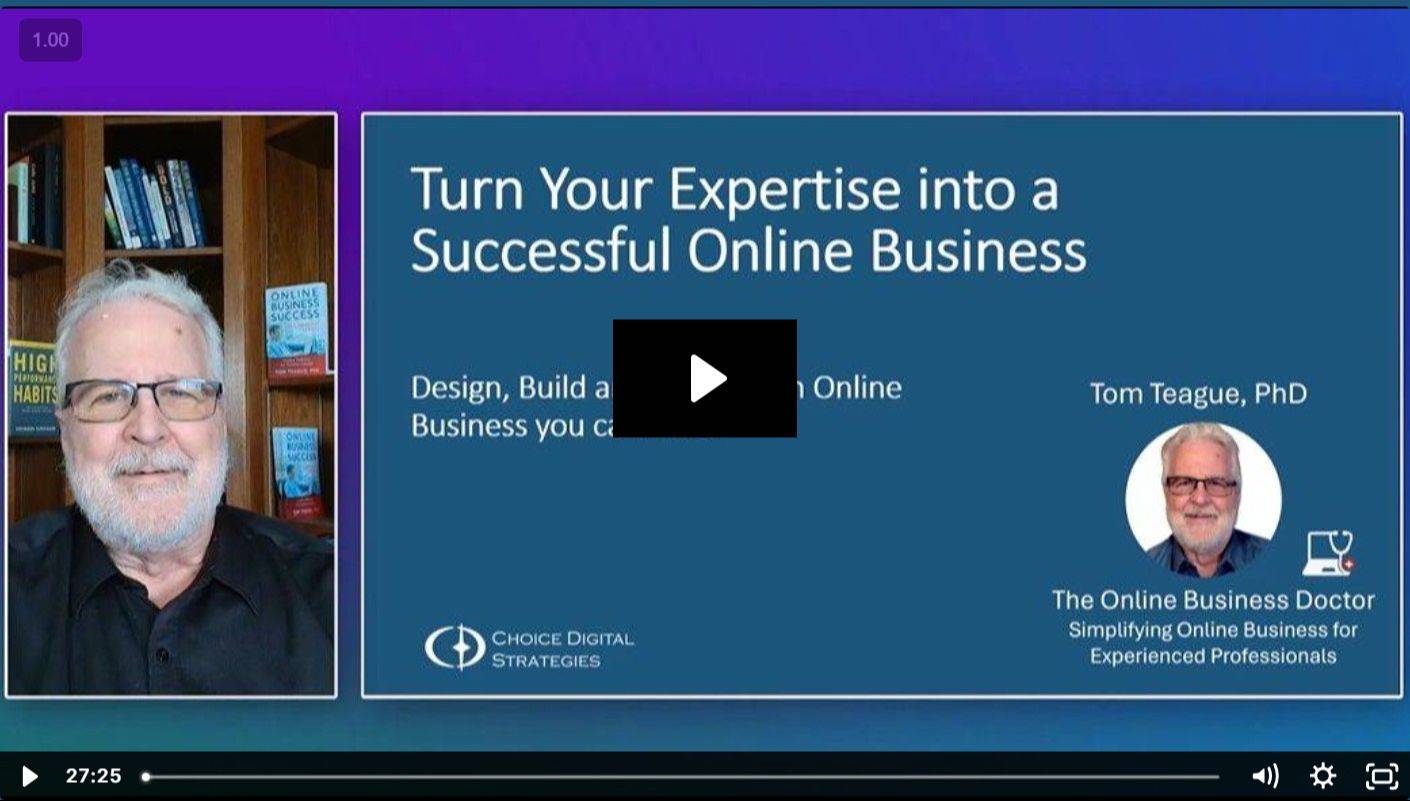
The example in the presentation combines books, workshops, courses, group coaching, and private coaching to produce $9,500 in revenue. The point isn't that this is the right mix. It's that you can begin intentionally designing your mix.
One Framework Can Become a Business
Instead of asking, “What product should I create?”, start with the transformation you provide and identify meaningful splinters of your framework. Match those splinters with delivery formats appropriate for different clients and different stages of the customer journey.
Then align the value, pricing, and sales targets of those offers with the revenue goals for your business.
You may discover that you don't need to continually invent new things to sell.
One well-designed framework can become the foundation for multiple related offers and, ultimately, your online business revenue model.